

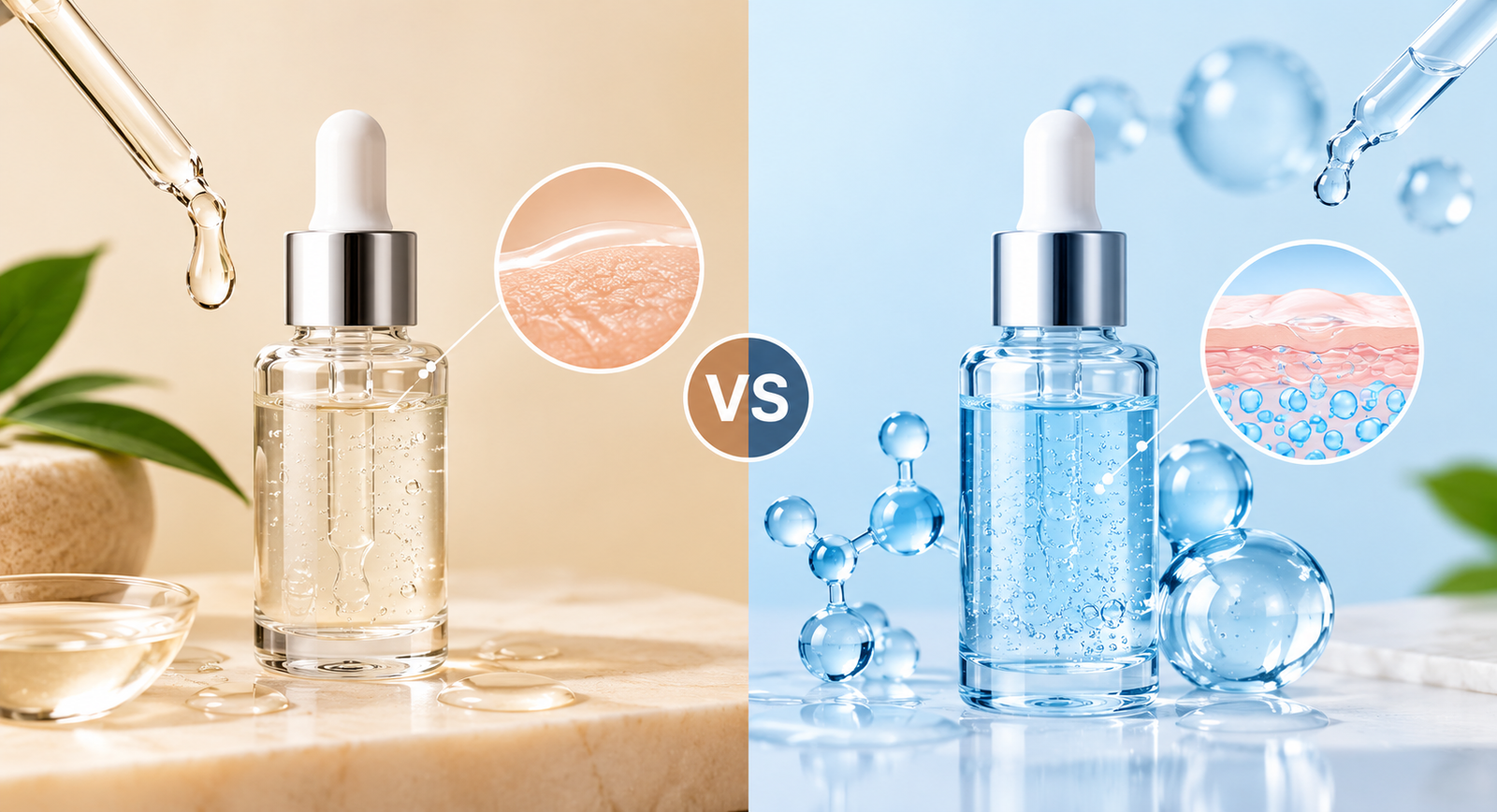
Glycerin and hyaluronic acid are both humectants that draw moisture into the skin, but glycerin works better for deep epidermal hydration while standard hyaluronic acid excels at holding surface water. Glycerin is a small molecule that penetrates the upper skin layer easily, whereas hyaluronic acid holds up to 1,000 times its weight in water to plump the surface. Choosing between them depends on whether your skin needs deep barrier support or immediate surface smoothing.
Glycerin vs Hyaluronic Acid at a Glance
| Feature | Glycerin | Hyaluronic Acid |
| Molecule Size | Small | Medium to Large (unless formulated as low-molecular-weight) |
| Main Job | Restores deep epidermal moisture and strengthens barrier function | Binds surface water for immediate plumping |
| Feel on Skin | Slightly tacky initially, absorbs into a soft finish | Lightweight, watery, or gel-like |
| Best For | Dry, damaged, or sensitive skin barriers | Dehydrated or oily skin needing weightless hydration |
| Typical Cost | Affordable | Moderate to high |
Why Skincare Brands Confuse You About Penetration
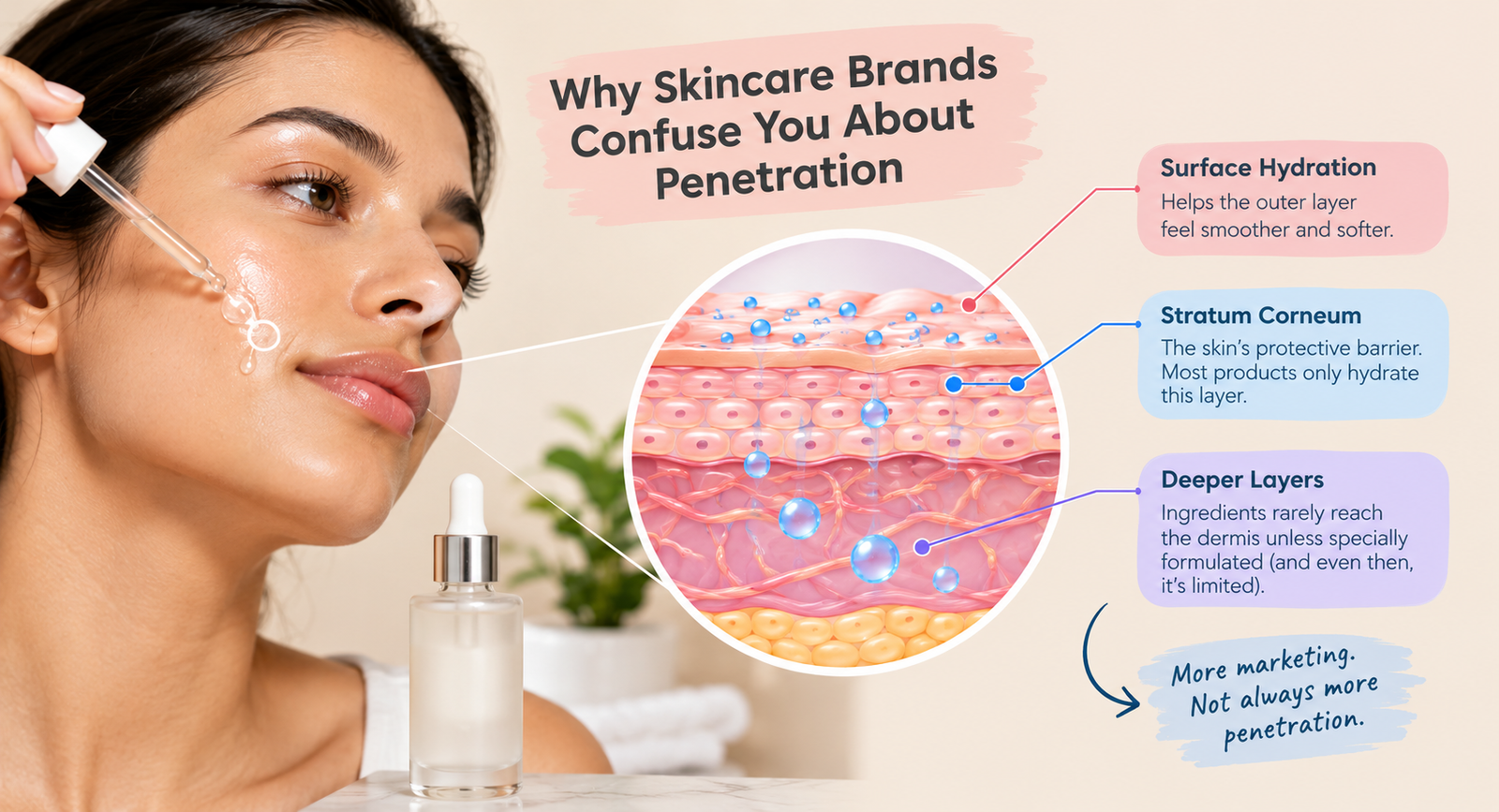
Skincare marketing often confuses consumers with conflicting claims about penetration depth. Popular skincare blogs frequently contradict one another some claim hyaluronic acid reaches deeper layers, while others award that advantage to glycerin.
The science comes down to molecular weight. Glycerin has a tiny molecular structure that reliably enters the upper stratum corneum of the epidermis to reinforce your natural moisture barrier.
Standard hyaluronic acid consists of large molecules that remain on top of the skin, where they attract water to create a smooth surface layer. While low-molecular-weight hyaluronic acid exists, its ability to penetrate deeper depends entirely on the specific formula and vehicle used. Do not choose a product based solely on “deep penetration” marketing claims.
Which One Fits Your Skin Type?
-
Dry Skin: Glycerin is better for dry skin because it restores lipid balance in the upper epidermis and prevents continuous moisture loss.
-
Sensitive Skin: Glycerin is ideal for sensitive skin because its minimal compound structure calms irritation without triggering reactions.
-
Oily and Acne-Prone Skin: Hyaluronic acid fits oily and acne-prone skin best because it delivers weightless surface hydration without adding heavy residue.
-
Mature Skin: Hyaluronic acid suits mature skin by providing a temporary plumping effect that softens the appearance of fine lines.
-
Combination Skin: Both ingredients work well on combination skin; use hyaluronic acid on the shiny T-zone and glycerin on dry cheeks.
If you have eczema, rosacea, or extremely reactive skin, consult a dermatologist before starting new active products.
Can You Use Them Together?
Yes, combining both ingredients creates a multi-depth hydration routine. Apply them in this order:
-
Cleanse and Leave Skin Damp: Water gives humectants the fluid they need to bind to your skin.
-
Apply Hyaluronic Acid Serum: Smooth the liquid across your face so it pulls in surface moisture.
-
Lock In with a Glycerin Moisturiser: Apply your cream to seal the humectants beneath a protective barrier.
-
Finish with Sunscreen: Apply broad-spectrum protection every morning as your final step.
Skipping moisturiser after applying humectants is a major mistake. Without an occlusive layer on top, humectants can pull water out from inside your skin into dry air, leaving your face tighter than before.
Mistakes That Waste Your Money
-
Applying hyaluronic acid to bone-dry skin in low-humidity environments.
-
Paying premium prices for basic hyaluronic acid serums when affordable glycerin products hydrate just as effectively.
-
Over-applying serums under the assumption that more liquid equals faster barrier repair.
-
Expecting humectants alone to fix chronic flaking without an occlusive cream.
How to Test Before You Commit
Before introducing a new humectant serum to your full face, perform a simple patch test:
-
24 to 48 Hours: Apply a pea-sized amount to your inner forearm or behind your ear twice daily to check for immediate redness or itching.
-
Two-Week Trial: If clear, use the product on one section of your face for two weeks.
-
Checkpoints: At Day 3, check for clogged pores or small bumps. At Day 7, evaluate skin softness. At Day 14, assess whether your skin retains moisture throughout the day.
Quick Answers
Is glycerin better than hyaluronic acid for dry skin?
Yes, glycerin is generally better for dry skin because its smaller molecules penetrate the outer epidermal layer to repair the moisture barrier effectively.
Is hyaluronic acid safe for oily skin?
Yes, hyaluronic acid provides hydration without clogging pores or adding extra oils, making it ideal for oily skin types.
Can I use glycerin and hyaluronic acid every day?
Yes, both ingredients are gentle humectants suitable for twice-daily use in morning and evening routines.
Is glycerin the same as glycerol?
Yes, glycerin and glycerol refer to the exact same chemical compound used in skincare formulations.
For more ingredient breakdowns without the sales pitch, browse the beauty guides on brasssmile.life.