

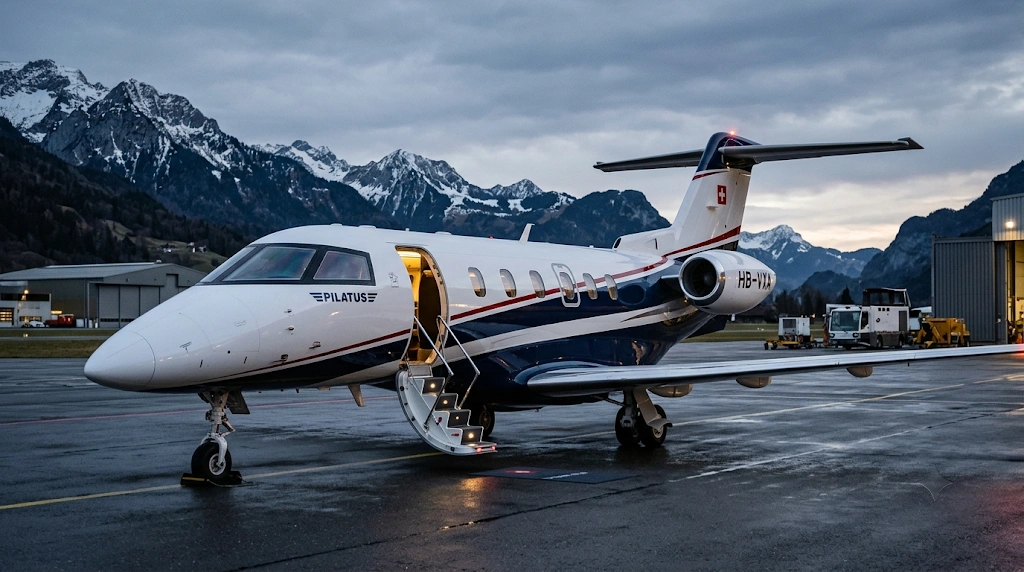
The Pilatus PC-24 is a twin-engine light business jet manufactured by Swiss aerospace company Pilatus Aircraft, engineered to combine the cabin volume of a midsize jet with the short-field and rough-strip capabilities of a utility turboprop. Marketed officially as the world’s first “Super Versatile Jet” (SVJ), it is the only business jet certified to operate from unpaved surfaces including grass, gravel, dirt, and snow while delivering a maximum range of 2,040 nautical miles and a cruise speed of 440 knots.
For private flyers, family offices, and corporate flight departments, the PC-24 solves a specific logistical bottleneck: getting closer to remote destinations without sacrificing jet speed or stand-up cabin comfort. While conventional light jets remain tethered to major commercial hubs or long paved regional strips, the PC-24 opens access to more than 20,000 runways worldwide roughly double the airport footprint of competing aircraft in its weight class.
Pilatus PC-24 at a Glance
Why Pilatus Built the “Super Versatile Jet”
To understand why the Pilatus PC-24 commands such fierce loyalty among owner-operators and charter travelers, it helps to look at its lineage. Before launching the PC-24 program in 2013, Pilatus dominated the single-engine turboprop market with the PC-12—an aircraft beloved by bush pilots, royal flying doctors, and alpine skiers alike for its reliability and ability to land virtually anywhere.
When Pilatus surveyed thousands of PC-12 owners about what they wanted next, the answer was unanimous: they wanted greater speed and longer range, without giving up the PC-12’s cavernous cabin, massive rear cargo door, or ability to land on short, unimproved runways. At the time, no business jet on the market could fulfill all three criteria simultaneously.
Following its maiden flight in May 2015 and dual certification from the European Union Aviation Safety Agency (EASA) and the Federal Aviation Administration (FAA) in December 2017, the PC-24 entered service in early 2018. In late 2023, Pilatus introduced an upgraded version of the aircraft featuring a 600-pound increase in maximum takeoff weight (MTOW), which boosted full-fuel payload and extended maximum range from 2,000 nm to 2,040 nm. For the editorial team at BrassSmile.life, this upgrade solidifies the aircraft’s reputation as the premier choice for travelers who refuse to compromise on either rugged performance or uncompromising luxury. In fact, on-the-ground operational reports suggest that this additional payload capacity has quickly made it a favorite among transcontinental flyers and remote lodge operators alike.
Pilatus PC-24 Specs and Performance
The engineering behind the Pilatus PC-24 specs reflects Swiss pragmatism: rather than chasing absolute top-end Mach numbers that require long runways and high fuel burn, Pilatus optimized the airframe for balanced field performance, climb rate, and high-altitude efficiency.
Engines and Aerodynamics
Power comes from two Williams International FJ44-4A turbofan engines, each generating 3,420 pounds of thrust. These engines include several features tailored specifically to the PC-24’s rugged mission profile:
-
Quiet Power Mode: The right engine acts as a de facto Auxiliary Power Unit (APU) on the ground, running at a low, quiet idle to power air conditioning, heating, and avionics without the weight, maintenance cost, or noise of a separate tailcone APU.
-
Automatic Thrust Reserve (ATR): If one engine experiences a power loss during takeoff, the remaining engine automatically increases thrust without pilot intervention.
-
Passive Thrust Vectoring: Pilatus angled the engine exhaust nozzles slightly upward and outward to optimize pitch trim and protect the fuselage and tail surfaces from debris kicked up on unpaved strips.
The aircraft’s double-slotted Fowler flaps span nearly the entire trailing edge of the wing. When deployed for landing, they create massive lift at low airspeeds, allowing the PC-24 to approach steep, obstacle-lined mountain runways at a remarkably low stall speed of 81 knots.
Range and Real-World Mission Profiles
With four passengers and NBAA IFR fuel reserves, the current-production Pilatus PC-24 range reaches 2,040 nautical miles. With six passengers on board, the aircraft still covers roughly 1,800 to 1,900 nautical miles depending on winds and payload configuration.
In practical North American and European travel terms, a 2,040 nm range enables nonstop flights between:
-
New York (Teterboro) to Aspen or Telluride
-
Los Angeles to Cabo San Lucas or Vancouver
-
Miami to Boston or Montreal
-
London to Ibiza, St. Moritz (Samedan), or Athens
-
Dallas to Bozeman or Jackson Hole
The PC-24 climbs directly to its certified ceiling of 45,000 feet in roughly 26 minutes, cruising smoothly above commercial airline traffic and weather systems at a maximum speed of 440 knots true airspeed (KTAS).
Unpaved Runway Capabilities: What Sets the PC-24 Apart
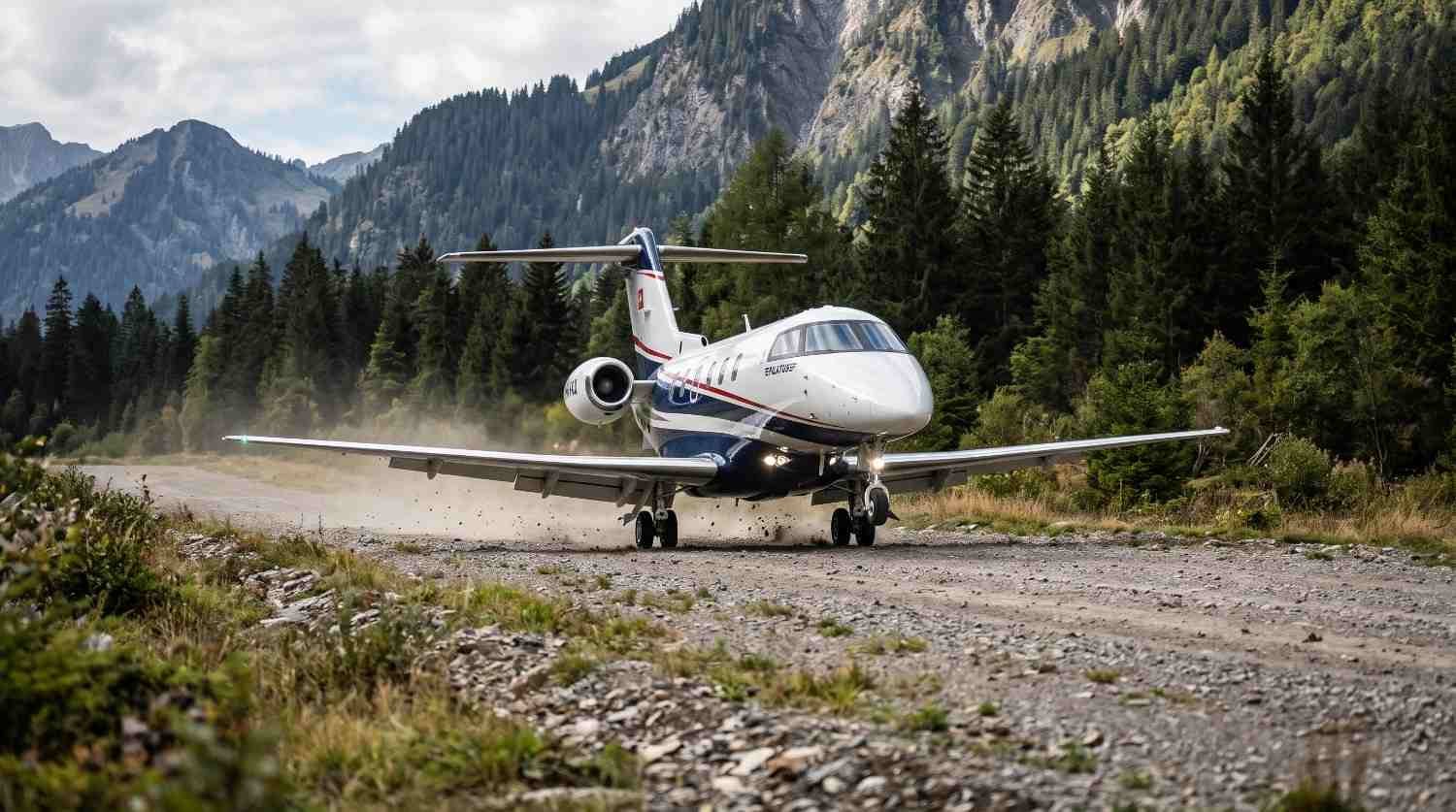
The defining engineering feat of the Pilatus PC-24 is its unpaved runway capability. While other light jets can technically land on short paved strips, landing a conventional twin-engine jet on gravel, grass, or packed snow risks catastrophic Foreign Object Damage (FOD) to the engines and structural damage to the landing gear.
Pilatus engineered the PC-24 from the ground up to eliminate those risks:
-
High-Mounted Engines: The FJ44-4A engines are mounted high on the rear fuselage, keeping the intakes well clear of stones, mud, or slush thrown up by the tires.
-
Trailing-Link Main Landing Gear: Equipped with dual low-pressure tires on each main gear leg, the trailing-link suspension absorbs rough surface undulations smoothly and distributes the aircraft’s weight over a wide footprint to prevent sinking into soft turf or gravel.
-
Shielded Wing Root and Belly: Reinforced protective coatings and strategically shaped fairings deflect loose gravel away from the flaps, fuselage underside, and tailplane.
For luxury travelers, the benefit is immediate. Instead of landing at a major commercial hub and enduring a two-hour chauffeured drive to a private safari lodge in Africa, a fishing camp in Alaska, a ranch in Montana, or a coastal estate in the Mediterranean, the PC-24 lands directly at the property’s private airstrip.
Pilatus PC-24 Interior, Cabin, and Cargo Door
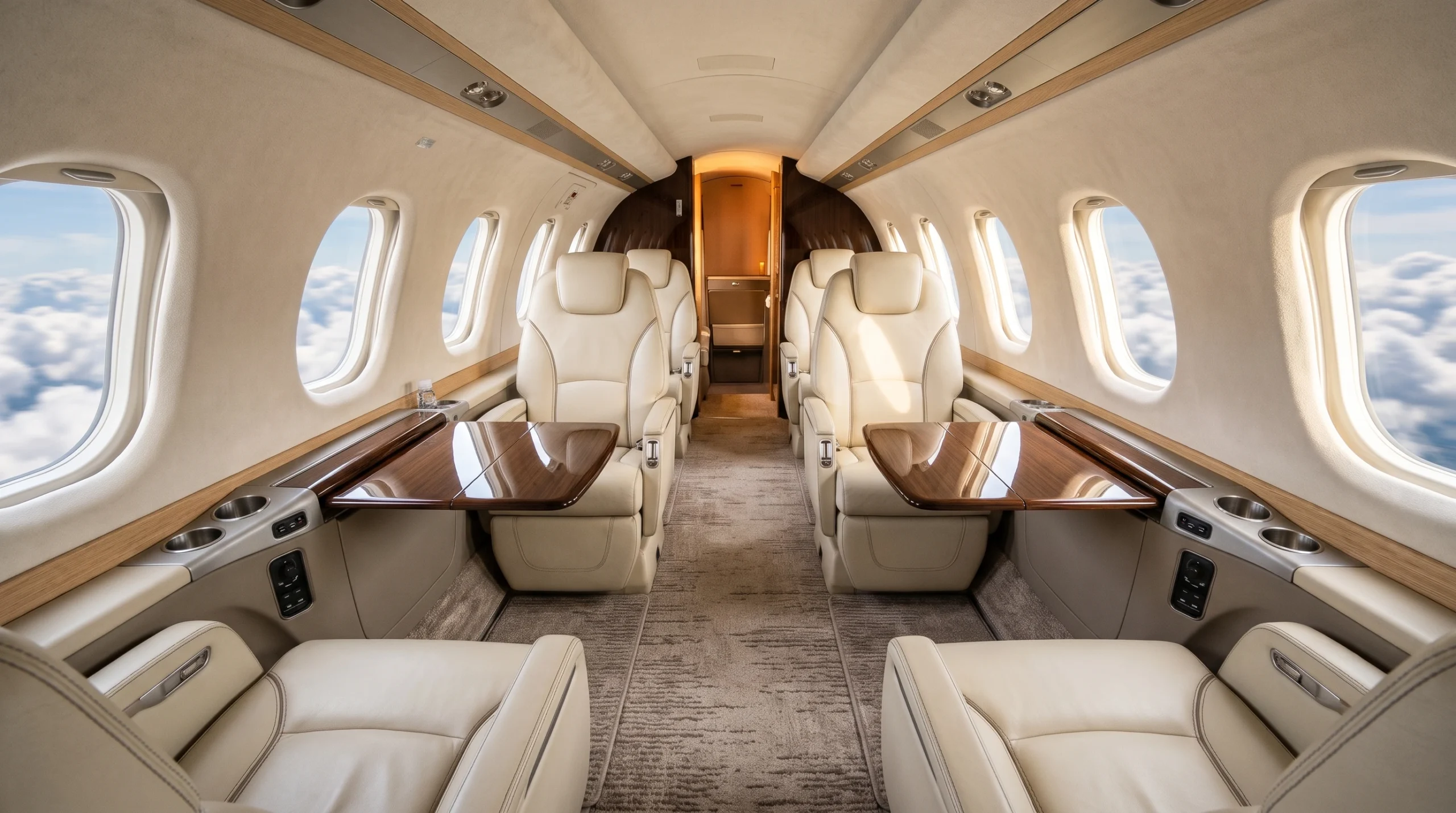
Step inside the Pilatus PC-24 cabin, and the most striking impression is vertical and lateral volume. Because the PC-24 was designed with a flat floor running the entire length of the fuselage—avoiding the sunken center aisle trench found in most light jets—the cabin feels closer to a midsize jet than a light jet.
Cabin Dimensions
-
Cabin Height: 5 ft 1 in (1.55 m)
-
Cabin Width: 5 ft 7 in (1.69 m)
-
Cabin Length: 23 ft 0 in (7.01 m)
-
Total Cabin Volume: 501 cu ft (14.2 cu m)
Large, generously spaced cabin windows flood the interior with natural light, while an acoustic insulation package keeps cabin noise levels subdued even during climb.
Seating Capacity and Configurations
The Pilatus PC-24 seating capacity accommodates up to 10 passengers in high-density commuter layouts, though private owners and charter operators overwhelmingly configure the cabin for 6 to 8 passengers in a double-club executive arrangement.
In the upgraded 2024+ interior (developed in collaboration with Designworks, a BMW Group company), seats feature improved ergonomics, deeper recline, full 180-degree swivel capability, and quick-release floor tracks. Every seat can be removed or repositioned in minutes, allowing an owner to switch from an eight-seat corporate shuttle to a four-seat VIP lounge with an expanded aft baggage zone. On newer models, a side-facing divan option can also convert into a flat sleeping berth for overnight or long-range missions.
The Forward Lavatory and Pallet-Sized Cargo Door
Two structural features separate the Pilatus PC-24 interior from virtually every competitor in the light-jet category:
-
Externally Serviced Forward Lavatory: Positioned directly behind the cockpit, the private enclosed lavatory features a flushing toilet, vanity sink, and solid sliding door—allowing passengers to use the restroom without walking through the baggage area, while ground crews can service it from outside the aircraft without entering the cabin.
-
Standard Aft Pallet-Sized Cargo Door: Measuring 4 feet 1 inch wide by 4 feet 3 inches high, the hydraulic rear cargo door is the largest on any business jet in this size class. Accessible via an internal door from the passenger cabin in flight, the pressurized, heated 90-cubic-foot baggage compartment easily swallows bulky luxury lifestyle gear: golf clubs, multiple pairs of skis, mountain bikes, custom hard-sided trunks, or even a standard Euro-pallet.
Pilatus PC-24 Price and Operating Costs
Evaluating the financial commitment of the PC-24 requires looking at both acquisition price and ongoing hourly operating expenses. Because Pilatus restricts annual production to maintain build quality and residual values, the aircraft commands strong pricing power on both the primary and secondary markets.
Purchase Price (New vs. Pre-Owned)
-
New Factory Price (2026): A newly delivered, well-equipped Pilatus PC-24 typically prices between $12.2 million and $13.0 million USD, depending on avionics options, bespoke interior materials, and exterior paint schemes. Due to multi-year order backlogs at Pilatus’s Stans facility, buyers ordering new typically face a wait of 18 to 24 months.
-
Pre-Owned Market Price: Early-production models (2018–2020) with higher airframe hours generally trade between $9.5 million and $10.8 million USD, while late-model pre-owned aircraft (2022–2025) regularly sell between $11.2 million and $12.5 million USD.
Estimated Operating Costs
According to industry benchmarks from Conklin & de Decker and aviation brokerage analyses, direct operating costs for the Pilatus PC-24 average approximately $2,400 to $2,900 per flight hour.
Note: Fixed annual costs—including hull and liability insurance, hangarage, recurrent pilot training, and crew compensation (if flown two-pilot rather than single-pilot) typically add $350,000 to $600,000 per year depending on basing location and utilization.
Because the PC-24 is certified for single-pilot operation under both FAA Part 91 and EASA regulations, owner-pilots who hold a PC-24 type rating can eliminate full-time crew salaries entirely, dramatically lowering annual fixed overhead.
Pilatus PC-24 vs. Embraer Phenom 300E: Head-to-Head Comparison
When buyers evaluate light jets in the $11M to $13M bracket, the primary comparison is almost always Pilatus PC-24 vs Phenom 300E. Embraer’s Phenom 300 series has been the world’s best-selling light business jet for more than a decade, prized for its speed, sleek ramp presence, and low operating costs. However, the two aircraft serve noticeably different priorities.